
The Trilateral Committee Endorses the Development of a Coordinated Approach for Grassland Conservation in the United Mexican States, the United States of America, and Canada
The central grasslands of North America occupy a broad swath of the midcontinent that was once a contiguous ecosystem stretching from what is today southern Canada to northern Mexico. These grasslands are home to a plethora of wildlife including some unique species that occur nowhere else on earth. It also holds an important biogeographical role by separating forested ecosystems that have a rich historical and present significance to many nations and people. Today, all North America’s grassland types are among the world’s most endangered ecosystems, and grassland bird populations suffer some of the steepest declines of any group of birds on the continent.
During the 2023 annual Canada/Mexico/U.S. Trilateral Committee for Wildlife and Ecosystem Conservation and Management (Trilateral Committee) meeting, a Letter of Intent (LOI) was signed by the Secretaría de Medio Ambiente y Recursos Naturales’ Dirección General de Vida Silvestre (DGVS); the U.S. Department of the Interior’s U.S. Fish and Wildlife Service (USFWS), and Environment Climate Change Canada’s Canadian Wildlife Service (CWS).
The LOI provides a framework for the following agencies to renew and strengthen their collaborative efforts to preserve the grasslands of the Great Plains of North America:
- Comision Nacional para el Conocimiento y Uso de la Biodiversidad (CONABIO)
- Comision Nacional de Areas Naturales Protegidas (CONANP)
- Direction General de Vida Silvestre (DGVS) of SEMARNAT
- United States Fish and Wildlife Service (USFWS)
- United States Geological Survey (USGS)
- Environment and Climate Change Canada (ECCC)
Before and after of a shrub control project conducted within the Sustainable Grazing Network (Red de Pastoreo Sostenible).
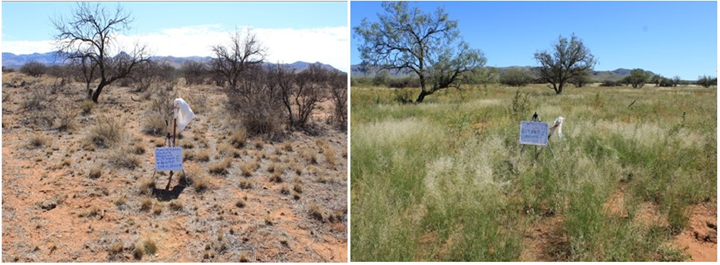
This LOI was jointly created by the Migratory Birds, Ecosystem Conservation, and Species of Common Conservation Concern working tables. The LOI recognizes the need to develop further expertise in ecological restoration, agriculture (“grass-based economies”) and agricultural policy, human dimensions, and social sciences relevant to land-use and land-management choices, Indigenous Knowledge Systems and cultural expertise, fire ecology, climatology, continent-wide geospatial tracking of grassland extent and condition, and other disciplines with a bearing on the maintenance of ecosystem function and grassland species.
Partners
In addition to being a home for unique wildlife and places of deep cultural and spiritual meaning, grasslands are also “working landscapes” and essential for food production. Grasslands, the diversity of people, and worldviews they support require landscape-level, innovative, cooperative, and interdisciplinary approaches to conservation.
Existing international collaboration examples include:
- Central Grasslands Roadmap (https://grasslandsroadmap.org): To date, over 600 people have come together in a virtual summit and in-person summit and formed working groups to create a "roadmap" for grasslands.
- JV8 grassland initiative (https://jv8.org): Eight joint ventures from southern Canada to northern Mexico have united to develop a strategy to improve grassland conservation in their work.
- North America Intergovernmental Committee on Cooperation for Wilderness and Protected Areas Conservation (NAWPA, https://nawpacommittee.org).
- CEC grasslands initiative (2022 – 2024: http://cec.org/grasslands-conservation-and-migratory-birds) supporting improved, standardization of grasslands inventory and measurement of grassland loss, enhanced incorporation of human dimensions and social science into our grassland conservation efforts, and increased diversity of underrepresented groups in international grasslands efforts.
- The Buffalo Treaty (https://buffalotreaty.com): Forty First Nations signatories have jointly committed to their vision of rematriating the bison, a keystone grazing species, to the former home in the Great Plains and beyond.
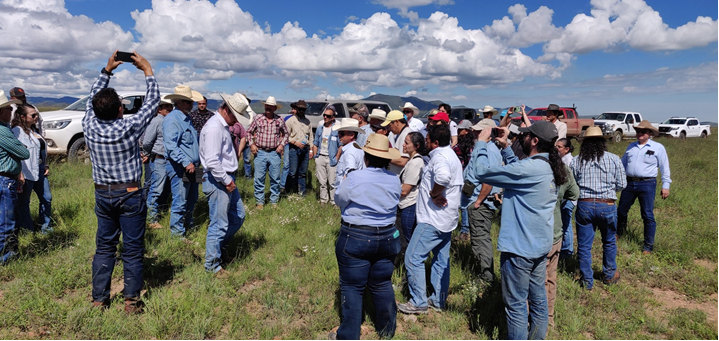
Conservation groups and ranchers took part at an event to increase collaboration for grasslands conservation in northern Mexico.
Featured Projects
- Red de pastoreo sostenible / Sustainable Grazing Network https://pastoreosostenible.mx)
- Conservation Investment Strategy for the Chihuahuan Desert Grasslands.
- JV8 implementation strategy: http://jv8.org/wp-content/uploads/2022/04/JV8-Central-Grasslands-Conservation-Initiative-Implementation-Strategy-%E2%80%93-2021-to-2024-Final.pdf
- Buffalo Nations Grasslands Alliance ( https://bngalliance.org is working to "ensure that the Native nations in the U.S. portion of Northern Great Plains have the technical and financial resources to plan and act on their vision for their traditional lands and waters."
- Other Indigenous-led conservation initiatives including the Iinnii Initiative (https://blackfeetnation.com/iinnii-buffalo-spirit-center), Naapi's Garden and Katoyiss Seed Bank ( https://naapisgardenkepa.com), and many others.
For more information:

Richardson, Valencia
International Affairs Specialist
International Affairs Specialist
Credit : Blackland Prairie Texas Restoration – Steve Arey/USFWS